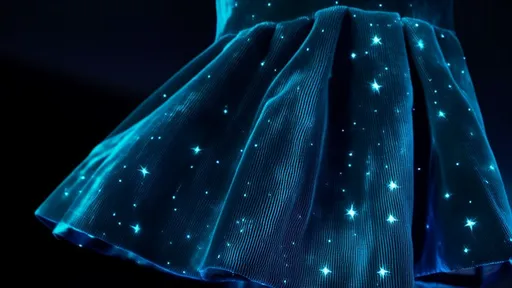
In an era where urban illumination often drowns out celestial wonders, a quiet revolution in textile technology is bringing the cosmos closer to home. Glow-in-the-dark corduroy fabric, embedded with advanced photoluminescent compounds, has emerged as an unexpected medium for capturing the ephemeral beauty of star trails within domestic spaces. This innovative material transcends its utilitarian origins, transforming ordinary home textiles into canvases that preserve celestial movements with remarkable fidelity.
The science behind these luminous textiles traces its lineage to strontium aluminate-based pigments, a far cry from the zinc sulfide formulations that once dominated the glow-in-the-dark market. When exposed to natural or artificial light sources, these next-generation photoluminescent fibers absorb and store photons at unprecedented efficiency. Unlike their predecessors that faded within minutes, modern variants can emit a soft, otherworldly radiance for hours after charging - a property that textile engineers have harnessed to mimic the sweeping arcs of celestial rotation across fabric surfaces.
Designers working with photoluminescent corduroy employ the fabric's distinctive ridged texture to create dimensional light effects. The parallel wales characteristic of corduroy serve as microscopic channels that guide and amplify luminosity. By strategically varying the nap direction and wale thickness, craftsmen can simulate everything from the delicate brushstrokes of meteor showers to the grand curvature of the Milky Way. The result is a textile that doesn't merely glow, but tells a luminous story as the viewer's perspective shifts.
Applications extend beyond aesthetic novelty. Sleep researchers have taken interest in bedding fashioned from these materials, noting how the gradually fading celestial patterns may help regulate circadian rhythms. The fabric's gentle emission spectrum - typically peaking around 520nm wavelength - appears to stimulate melatonin production without the sleep-disrupting effects of blue light. Early adopters report that falling asleep beneath a corduroy "star map" duvet cover creates a meditative state reminiscent of camping under open skies.
Environmental considerations have driven much of the technology's refinement. Contemporary photoluminescent textiles forego radioactive tritium and other hazardous materials that plagued early glow-in-the-dark products. Instead, they rely on rare-earth doped aluminates that are chemically inert and non-toxic. The manufacturing process has evolved to embed these phosphors at the polymer stage rather than applying them as surface coatings, resulting in fabrics that maintain their luminous properties through hundreds of wash cycles without leaching microplastics.
Architectural applications are pushing the boundaries of this technology. Interior designers in light-polluted urban centers are installing photoluminescent corduroy wall panels that recreate specific astronomical events. One notable Tokyo high-rise features a lobby installation tracking the 2020 Great Conjunction of Jupiter and Saturn across a corduroy tapestry spanning twenty meters. The piece charges during daylight hours through strategically placed skylights, then reveals its celestial narrative as evening falls.
The cultural implications of this synthesis between astronomy and textile arts are profound. In an age where digital screens dominate our visual experiences, these tactile star maps offer a physical connection to cosmic phenomena. Museums have begun commissioning custom pieces - a Berlin exhibit currently displays a corduroy representation of comet NEOWISE's trajectory based on astrophysical data from the Palomar Observatory. The fabric's ridges precisely map the comet's parabolic path, with varying glow intensities corresponding to its changing luminosity during approach.
Future developments suggest even more sophisticated applications. Researchers at the Swiss Federal Laboratories for Materials Science are experimenting with quantum dot-enhanced variants that could display full-color celestial simulations. Meanwhile, a Cambridge-based startup has prototyped corduroy that changes its luminous pattern based on real-time astronomical data feeds, potentially allowing wearers to "carry" accurate representations of the night sky specific to their geographic location and time zone.
This convergence of ancient craft and space-age technology speaks to a fundamental human desire - to bring the vastness of the cosmos within reach, quite literally. As photoluminescent textiles continue evolving, they promise to redefine our relationship with both the night sky and the fabrics that surround us daily. The humble corduroy, reinvented through materials science, has become an unexpected bridge between celestial mechanics and tactile human experience.

By /Aug 13, 2025

By /Aug 13, 2025

By /Aug 13, 2025

By /Aug 13, 2025
By /Aug 13, 2025

By /Aug 13, 2025

By /Aug 13, 2025
By /Aug 13, 2025

By /Aug 13, 2025

By /Aug 13, 2025
By /Aug 13, 2025

By /Aug 13, 2025

By /Aug 13, 2025

By /Aug 13, 2025

By /Aug 13, 2025

By /Aug 13, 2025
By /Aug 13, 2025

By /Aug 13, 2025

By /Aug 13, 2025

By /Aug 13, 2025
