0.08mm Cashmere Extreme: Breakthrough in Nano Spinning Technology

Aug 13, 2025 By

The textile industry has long been chasing the elusive dream of spinning ultra-fine cashmere fibers, pushing the boundaries of what was once considered physically impossible. For decades, the 0.08mm diameter mark stood as an unbreakable barrier – until now. A groundbreaking development in nano-spinning technology has shattered this limitation, opening doors to a new era of luxury fabrics with unprecedented softness and thermal properties.

The 0.08mm Barrier: Why It Mattered

Cashmere's value has always been tied to fiber fineness. Traditional wisdom held that 0.08mm represented the absolute lower limit for spinnable cashmere fibers – any thinner and the fibers would lack sufficient structural integrity for processing. This limitation forced manufacturers to balance between fineness and practicality, often sacrificing one for the other. The finest cashmere garments still contained fibers hovering near this threshold, leaving textile scientists wondering if nature's design could be improved upon.

What few anticipated was how dramatically nanotechnology could rewrite these rules. By reengineering the fundamental approach to fiber formation rather than simply refining existing methods, researchers have achieved what mechanical processing alone never could. The implications extend far beyond creating softer sweaters – this breakthrough challenges our basic understanding of natural fiber manipulation.

Nano-Spinning's Secret: Molecular Alignment

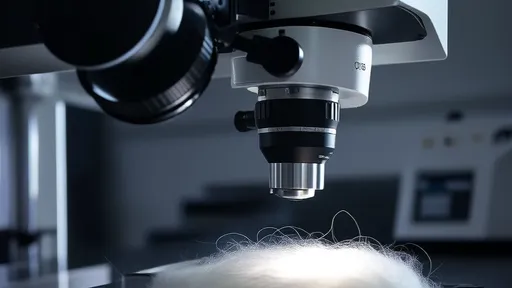
The key innovation lies in controlling fiber formation at the molecular level. Conventional spinning stretches pre-formed fibers thinner, while the new technique builds fibers from carefully aligned protein chains. Using electromagnetic fields to orient cashmere keratin molecules during extrusion, scientists can now create continuous filaments measuring as fine as 0.02mm – four times thinner than the previous "unbreakable" limit.

This molecular precision achieves two seemingly contradictory goals simultaneously: extreme fineness without sacrificing strength. The aligned molecular structure compensates for reduced fiber diameter by eliminating weak points that normally develop during mechanical processing. Early testing shows the nano-spun fibers actually surpass conventional cashmere in tensile strength while weighing significantly less.

From Laboratory to Luxury

Translating this technology from lab experiments to commercial production presented formidable challenges. Scaling up the precise electromagnetic controls required completely rethinking textile manufacturing infrastructure. The solution emerged through hybrid systems combining traditional spinning machinery with nanotechnology modules – an approach preserving existing industry investments while enabling quantum leaps in product quality.

Pilot production runs have yielded astonishing results. Fabric samples demonstrate heat retention properties 30% superior to conventional cashmere at identical weights, with a hand feel described by testers as "liquid warmth." The enhanced surface area from ultra-fine fibers creates unique light interaction effects, giving the material an almost luminous quality under certain lighting conditions.

Environmental Implications

Perhaps the most unexpected benefit comes in sustainability. Producing warmer fabrics from less raw material could significantly reduce the environmental impact of cashmere production. Preliminary estimates suggest the technology might enable 40% reductions in goat herds needed to meet global cashmere demand, potentially easing grassland degradation in sensitive regions like Mongolia and Inner China.

The water savings prove equally impressive. Nano-spinning requires no chemical treatments to achieve fiber separation, eliminating one of traditional cashmere processing's most polluting steps. Early adopters are already marketing the technology as "dry processing" cashmere – a potentially transformative claim for eco-conscious luxury consumers.

The New Luxury Landscape

As the first nano-spun cashmere products reach premium retailers, pricing strategies reveal how manufacturers view this innovation. Rather than positioning it as a mass-market alternative, brands are introducing the technology at price points 50-70% above conventional premium cashmere. This reflects both current production costs and a deliberate strategy to maintain exclusivity while scaling up capacity.

The aesthetic possibilities are expanding as quickly as the technical ones. Designers report that the new fibers accept dyes with unprecedented clarity and uniformity, enabling color effects previously impossible with natural fibers. Some experimental weaves combine nano-spun and conventional cashmere in single garments to create texture gradients that feel different across a single piece of clothing.

Challenges Ahead

Not all industry observers are convinced this revolution will proceed smoothly. Traditional cashmere producers express concerns about protecting geographical indications and quality standards. There are active debates about whether nano-spun cashmere should qualify as "natural fiber" under various labeling regulations – a decision with significant marketing and tariff implications.

Consumer acceptance also remains an open question. While early adopters enthusiastically embrace the technological story, some heritage luxury buyers remain skeptical of anything perceived as "engineered" cashmere. Marketing teams are carefully balancing innovation narratives with reassurances about preserving cashmere's essential character.

Beyond Cashmere: Wider Applications

The implications extend far beyond cashmere production. Researchers are already adapting the technology to other challenging natural fibers like qiviut (musk ox wool) and guanaco. There's even promising work applying similar principles to plant-based fibers, potentially revolutionizing materials like extra-fine cotton and linen.

Medical applications are particularly intriguing. The biocompatibility of nano-aligned keratin fibers shows promise for advanced wound dressings and even nerve regeneration scaffolds. Textile engineers collaborate with biomedical researchers to explore these cross-disciplinary possibilities, suggesting the 0.08mm breakthrough might represent just the first of many boundaries to fall.

As the industry digests these developments, one thing becomes clear: the rules of luxury textiles are being rewritten. What began as an effort to spin slightly finer cashmere has uncovered entirely new approaches to working with natural fibers. The 0.08mm barrier now stands as a reminder of how technological leaps can transform even the most established industries.

Recommend Posts
Fashion

Luxury Rebound: The Revenge of Maximalism in Gen Z

By /Aug 13, 2025

The fashion cycle has always been a pendulum swinging between extremes, but few could have predicted the sudden resurgence of maximalism among Gen Z. Just as the world seemed to settle into the quiet luxury trend—think Loro Piana cashmere and understated Bottega Veneta—a riot of color, texture, and unabashed excess is staging a dramatic comeback. This isn’t your grandmother’s maximalism, though. The new wave is sharper, more self-aware, and deeply intertwined with digital culture.
Fashion

National Brand Goes West 2.0: Erke's Milan Flagship Store Makes a Comeback"

By /Aug 13, 2025

In the heart of Milan’s fashion district, a new player has emerged, turning heads and challenging the dominance of Western sportswear giants. Hongxing Erke, a Chinese sportswear brand once overshadowed by international competitors, has made a bold statement with its flagship store in Milan. This move marks a significant milestone in the brand’s "Go West 2.0" strategy, an ambitious plan to expand its global footprint and redefine its image.
Fashion

Museum IP Battle: The Metropolitan's Fashion Licensing Empire

By /Aug 13, 2025

The Metropolitan Museum of Art has long been revered as a bastion of culture, housing some of the world’s most iconic artworks. But in recent years, the museum has expanded its influence far beyond its hallowed halls, venturing into the lucrative world of fashion licensing. The Met’s foray into fashion collaborations has sparked a fierce battle among brands vying for the prestige of associating with its illustrious name. This isn’t just about clothing—it’s about legacy, exclusivity, and the power of cultural branding in an increasingly competitive market.
Fashion

Fast Fashion Collaboration Trap: Investigation into the Exploitation of Designer Value

By /Aug 13, 2025

The glittering spectacle of fast fashion collaborations has become a cultural phenomenon, where high-street giants routinely partner with avant-garde designers or celebrity creatives. These limited-edition capsule collections generate frenzied queues outside stores and crash websites within minutes of launch. Yet behind the carefully orchestrated hype lies an uncomfortable truth: these partnerships often function as sophisticated mechanisms for extracting and commodifying creative labor while offering designers shockingly little in return.
Fashion

The Paradox of Niche Brands: When Indie Designs Go Viral

By /Aug 13, 2025

The fashion industry thrives on exclusivity, yet it simultaneously craves mass appeal. This paradox lies at the heart of what we now call the Indie Brand Paradox—the phenomenon where independent designers achieve mainstream success, only to face an identity crisis. When a niche label becomes a viral sensation, it must navigate the treacherous waters between authenticity and commercial viability. The very elements that made it unique—limited production runs, artisanal craftsmanship, subversive designs—often become casualties of scalability.
Fashion

Intelligent Knitting: Thermosensitive Fibers Automatically Regulate Ventilation Holes

By /Aug 13, 2025

The textile industry is undergoing a quiet revolution as smart knitting technologies merge with advanced material science. At the forefront of this innovation lies temperature-sensitive fibers capable of autonomously adjusting garment breathability—a breakthrough that could redefine comfort in athletic wear, medical textiles, and everyday apparel. Unlike traditional moisture-wicking fabrics that rely on passive diffusion, these dynamic textiles physically reconfigure their structure in response to thermal stimuli.
Fashion

Creative Director Survival Report: Breaking the Three-Year Curse Solution

By /Aug 13, 2025

The creative industry moves at breakneck speed, and nowhere is this more evident than in the precarious tenure of creative directors. For years, the "three-year curse" has haunted the profession—that mysterious point when even the most brilliant minds seem to hit an invisible wall. But something unexpected is happening across agencies and in-house studios worldwide: a growing number of creative leaders are cracking the code to longevity.
Fashion

Luminous Corduroy: Phosphorescent Materials Create Star Tracks in the Dark

By /Aug 13, 2025

In an era where urban illumination often drowns out celestial wonders, a quiet revolution in textile technology is bringing the cosmos closer to home. Glow-in-the-dark corduroy fabric, embedded with advanced photoluminescent compounds, has emerged as an unexpected medium for capturing the ephemeral beauty of star trails within domestic spaces. This innovative material transcends its utilitarian origins, transforming ordinary home textiles into canvases that preserve celestial movements with remarkable fidelity.
Fashion

Spider Silk Protein Shirts: Biotech Disrupts the Definition of Luxury

By /Aug 13, 2025

The fashion industry stands on the brink of a biological revolution as spider silk protein shirts emerge from laboratories to challenge the very definition of luxury. For centuries, opulence in apparel has been synonymous with rare materials and artisanal craftsmanship – think Italian cashmere, Swiss lace, or Japanese denim. But in a quiet laboratory in San Francisco, a team of biotechnologists has been cultivating vats of silky protein filaments that could render these traditional status symbols obsolete.
Fashion

Self-Healing Denim: Microencapsulation Repair Technology Overcomes Hole Challenges

By /Aug 13, 2025

In a groundbreaking development for sustainable fashion, scientists have unveiled a revolutionary self-healing denim technology that could forever change how we deal with worn-out jeans. The innovation centers around microcapsule repair systems embedded within the fabric itself, offering what experts are calling "the holy grail" of textile durability.
Fashion

0.08mm Cashmere Extreme: Breakthrough in Nano Spinning Technology

By /Aug 13, 2025

The textile industry has long been chasing the elusive dream of spinning ultra-fine cashmere fibers, pushing the boundaries of what was once considered physically impossible. For decades, the 0.08mm diameter mark stood as an unbreakable barrier – until now. A groundbreaking development in nano-spinning technology has shattered this limitation, opening doors to a new era of luxury fabrics with unprecedented softness and thermal properties.
Fashion

Morandi Trap: When Low Saturation Becomes a New Aesthetic Dictate

By /Aug 13, 2025

In recent years, the muted, understated palette of Giorgio Morandi has seeped into every corner of visual culture—interior design, fashion, branding, and even digital interfaces. What began as an appreciation for subtlety has morphed into a pervasive aesthetic regime, one that dictates taste under the guise of sophistication. The "Morandi tone," with its chalky pinks, dusty blues, and washed-out beiges, is now the unofficial uniform of contemporary minimalism. But as this trend hardens into dogma, a quiet rebellion brews: when does restraint become repression?
Fashion

Dynamic Gradient Breakthrough: Liquid Crystal Fabric Achieves Automatic Color Change

By /Aug 13, 2025

In a groundbreaking leap for smart textiles, researchers have unveiled liquid crystal fabrics capable of dynamic color-shifting without external power sources. This innovation promises to revolutionize industries from fashion to military camouflage by creating materials that adapt to environmental changes in real time.
Fashion

Mineral Dye Revolution: Cosmic Deep Blue Dye Made from Meteorite Powder

By /Aug 13, 2025

In a groundbreaking fusion of celestial wonder and terrestrial artistry, scientists and artisans have unlocked the secrets of the cosmos to create an extraordinary new pigment: cosmic deep blue, derived from meteorite powder. This revolutionary development in mineral dyes promises to redefine the boundaries of color, sustainability, and human connection with the universe.
Fashion

Fluorescent Taming Guide: Breaking Through Office Safety Dress Code

By /Aug 13, 2025

In the corporate jungle where neutral tones reign supreme, a quiet revolution is brewing. Fluorescent hues—long banished to construction sites and rave parties—are making an unexpected comeback in professional settings. This chromatic insurgency isn’t about reckless self-expression; it’s a calculated strategy for visibility, safety, and psychological impact in modern workplaces.
Fashion

Urban Spectrum Showdown: Shanghai Blue vs. London Fog in Fashion Discourse

By /Aug 13, 2025

In the ever-evolving world of fashion, color serves as both a cultural signifier and a powerful tool for self-expression. Two iconic urban hues—Shanghai Blue and London Fog—have recently emerged as competing chromatic languages in global style narratives. These colors transcend mere aesthetic preferences; they embody distinct philosophies of urban life, historical legacies, and contemporary aspirations. The clash (and occasional fusion) of these tones reveals deeper currents about East-West fashion diplomacy in the post-pandemic era.
Fashion

The Paradox of 3D Sculpting from 2D: Secrets of Transforming Flat Patterns into Three-Dimensional Art

By /Aug 13, 2025

The art of transforming two-dimensional patterns into three-dimensional sculptures has long fascinated designers, mathematicians, and artists alike. At the heart of this transformation lies what some refer to as the "paradox of drape"—the seemingly magical leap from flat fabric or paper to a form that occupies space with volume, movement, and depth. This process, whether in fashion design, origami, or architectural modeling, challenges our understanding of how surfaces behave when freed from their planar constraints.
Fashion

Interstellar Universe: The Re-creation of New Chinese Symbols in a Space Theme"

By /Aug 13, 2025

The vast expanse of space has always served as a mirror to human culture, reflecting our deepest symbols and aspirations back to Earth. In recent years, an intriguing aesthetic fusion has emerged from China's space program - what cultural theorists are calling "Buckle Cosmos" - where traditional Chinese knotting techniques and architectural motifs collide with futuristic space technology.
Fashion

The Renaissance of Men's Lace: Gothic Aesthetics Returns to the Mainstream

By /Aug 13, 2025

The resurgence of lace in menswear is more than a fleeting trend—it’s a cultural reclamation. Once relegated to the fringes of fashion, lace is now stepping boldly into the mainstream, driven by a renewed fascination with Gothic aesthetics. Designers and wearers alike are embracing its delicate intricacy, not as a sign of fragility, but as a statement of subversion and sophistication. This revival isn’t merely about fabric; it’s a rebellion against rigid gender norms and a celebration of historical opulence reimagined for the modern man.
Fashion

Lace Heavy Metal: The Experimental Collision of Biker Jackets and Victorian Style

By /Aug 13, 2025

The fashion world thrives on contradictions, and few are as deliciously jarring as the marriage of lace and heavy metal. This season, designers are orchestrating a high-voltage collision between the delicate femininity of Victorian-inspired lace and the rebellious edge of motorcycle jackets. The result? A sartorial experiment that feels both nostalgic and dangerously modern.